
Dave’s Hot Chicken Calories and Nutrition Guide
Understand what is counted in a tender, slider or combo and why sides and sauces change your order.
A single-slider calorie number is not the same as a full meal with fries. Before comparing Dave’s tenders, sliders or combos, look at the exact serving and the food it includes. That gives you a much more useful picture than a number without its meal details.
Dave’s publishes official 2026 nutrition information. The single-slider example on an official ordering page lists a 620–680 calorie range. That is not the entire slider-and-fries combo. Always check the exact item, its portion and any extras.
Why the calorie total can change
Many menu sites publish one neat number beside every meal. That can make it seem as though the restaurant serves one fixed version of each food. In practice, the difference between a bare tender, a dressed slider and a combo with fries matters. A meal might include more than one piece of chicken. It may also include bread, pickles, slaw, sauce and a drink depending on what you select.
Heat can matter as well. An official slider ordering screen gives a range of 620 to 680 calories rather than one fixed value. That does not mean every slider at every location has the same range forever. It means the source accounts for variation within the product options it describes. The right place to start is the restaurant’s official 2026 nutrition document and the details of your order.
Chicken tenders and sliders are different servings
A tender is a separate piece of fried chicken. Dave’s commonly serves its tenders with sliced bread, pickles and a dipping sauce. A slider takes the chicken and places it inside a potato bun with kale slaw, pickles and a sauce drizzle. The bun and toppings help explain why a slider is not the same nutritional product as a tender, even though both use fried chicken.
If you are comparing two items, make sure the nutrition includes the same components you plan to eat. Some tables describe chicken alone while others include the bread and standard toppings. An extra cheese slice or more sauce changes the actual meal. Avoid comparing an individual tender from one chart with a full slider meal from another.
What the main nutrition numbers include. This table is a serving-size guide, not a made-up national calorie chart. For precise values, open the restaurant’s current nutrition documents.
| Menu item or question | What to consider | What to do |
|---|---|---|
| Single tender | A chicken item with its stated standard serving details | Confirm bread, sauce and chosen seasoning |
| Single slider | Chicken with a bun and standard toppings | Do not count it as a combo with fries |
| Numbered combo | Several items plus the listed fries | Compare the complete combo instead of one component |
| Loaded fries or mac | The side and whatever toppings or chicken are included | Read the exact version and portion |
| Shake or frozen drink | The selected size and flavor | Check toppings and extras separately |
What’s inside a numbered combo
Numbered combos: counting the whole order
Dave’s #1 contains two tenders with fries. #2 has two sliders with fries. #3 has one tender and one slider with fries. #4 has one slider with fries. The fries make every numbered combo different from the similarly named standalone chicken item. A useful calorie comparison must include the fries and any standard serving extras rather than just the main chicken.
Do not add two unrelated online calorie estimates together and assume the result must equal the restaurant’s officially reported combo. Serving descriptions and included sauces may differ. Use one up-to-date source for the whole order. If a table gives a range, report the range with the item’s name and the date of the source.
How to read the nutrition label
Calories describe the energy in a serving. Protein relates to building and maintaining body tissue. Total fat and saturated fat are not the same measure. Carbohydrates include several components of food. Sodium can be important for guests following medical or dietary advice. A good comparison considers the fields relevant to the reader rather than assuming the lowest-calorie item is automatically the healthiest.
Serving size is especially important. A box for several people must not be compared with a single slider on a one-to-one basis. If a food is listed per piece and your order contains four pieces, you need to account for all four. Be careful with group meals because not every side or dip is divided evenly.
How sides and drinks affect the meal
Fries, loaded fries and mac and cheese
Regular fries are a separate side as well as part of the numbered combos. Loaded fries may have cheese sauce, slaw, pickles and chicken bites or cauliflower pieces. A plain side of fries and a loaded plate therefore represent very different orders. The word fries does not describe all of the added ingredients.
Mac and cheese is a rich side made with cheese-based ingredients. Some topped mac items add fries, Buffalo sauce, ranch and bites. If you are comparing a side of mac with a loaded mac dish, read the actual serving description. One may be closer to a side while the other works as a substantial food order on its own.
Shakes and frozen drinks
A shake is not the same type of drink as bottled water or an unsweetened soft drink. Flavored shakes commonly contain milk and sweet ingredients. Top-loaded versions add ingredients such as cookies, cereal or candy. This can change both calories and allergens. Check the size and topping before adding a shake to a chicken combo.
Some Dave’s menus show slushers with fruit flavors and limited toppings. A frozen drink with syrup or another addition can differ from the standard fountain drink. You should not treat every drink in a category as having the same nutrition. Choose the exact size and flavor from the restaurant’s ordering menu when checking.
One tray can mean several different serving sizes
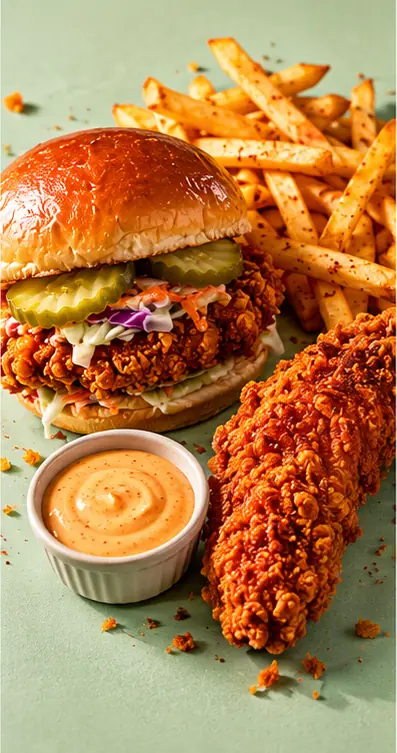
When you add fries, sauces or a sweet drink, the full order changes. This food image is illustrative and does not represent a verified standard serving.
Protein and choosing a complete order
Protein: useful context without a false guarantee
Fried chicken supplies protein. That does not mean a chicken item has the same protein and calorie balance across every meal. A tender by itself is different from a sandwich with a bun. The larger XL Slider is promoted by the restaurant as a substantial protein option. However, a marketing description is not a full nutrition label.
If your goal is to compare protein, look at the grams per full serving along with calories, fat and sodium. Consider what you will actually eat. Choosing two tenders instead of one slider changes both the protein amount and the rest of the meal. Avoid deciding solely from one number quoted without its serving size.
How to make a realistic calorie comparison
Start with the main food you want. Next identify whether your order includes fries. Add drinks and extra sauce as separate components only when you plan to have them. Check the quantity of each item. Read the nutrition source date, since recipes and menu options can change. If values are given as ranges, keep them as ranges.
For example, if you want one slider with fries, don’t use the calories for the single slider alone and call it the meal total. If you replace fries with cheese fries, the nutrition also changes. If you order a shake, include its size and toppings. This sounds basic, but it avoids most of the mistakes seen in oversimplified calorie tables.
How to check reliable nutrition details
Where the reliable numbers come from
The restaurant provides a 2026 nutrition and allergen information page. Its official documents are the best source for a current item-level lookup. An official single-slider ordering page also displays the 620–680-calorie range. Use that range only for the item shown there, not as a nationwide average for all sandwiches.
If you see wildly different numbers for the same meal, ask whether the sources count bread, fries, dips and toppings in the same way. Two articles can display different numbers because one includes the side while the other does not. When the source is unclear, do not turn a guess into a confident statement.
Nutrition and allergy information are different
An item with lower calories is not automatically safe for someone with a food allergy. Allergen questions concern ingredients and possible cross-contact. They need a separate check. Our Dave’s allergen guide explains what to ask the restaurant. The gluten-free options guide addresses breading and preparation concerns.
If you have a medical condition or follow an individualized nutrition plan, general online figures cannot replace advice from an appropriate healthcare professional. This website does not test food or inspect restaurant kitchens. It is an independent guide to finding and using restaurant-provided information.
What matters before you order
A good nutrition decision starts with accurate portions. Look at the entire order rather than a single food photo. Use the latest restaurant-published nutrition data and compare the exact tender, slider, fries, drink and sauce options you intend to have. That will be more useful than any unsupported ranking of the healthiest meal.
For the full menu, food names and location-labeled price examples, use our Dave’s Hot Chicken menu and prices homepage. It helps you choose the meal. The official nutrition document then helps you understand what is in that exact choice.
This independent guide is not owned by or affiliated with Dave’s Hot Chicken. Availability, ingredients and preparation can vary by restaurant.


