Dave’s Hot Chicken Allergen Menu: What to Check
A practical guide to checking breading, sauces, sides and cross-contact at your chosen restaurant.
A food photo can tell you that a slider has a bun and sauce. It cannot tell you every ingredient or how the kitchen handles shared equipment. When you have a food allergy, those missing details are often the most important ones.
Dave’s publishes official allergen information for 2026. Check the exact item and ask your location about cross-contact. This independent website does not certify any prepared item as allergen-free.
Where to find Dave’s allergen information
Dave’s provides a dedicated official page for its 2026 allergen and nutrition information. This is where visitors should begin when they need to know which ingredients matter for a food allergy. An independent menu article can explain where to look and which questions to ask, but it cannot replace the restaurant’s latest ingredient documentation or direct answers from the store.
Open the official Dave’s nutrition and allergen page. Review the relevant document and match the exact product name. A chicken tender, a slider and a loaded fries order should not be treated as the same food. If a new special is missing from the document, contact the restaurant and ask about the current recipe.
The nine major U.S. allergens
The U.S. Food and Drug Administration identifies nine major food allergens: milk, eggs, fish, crustacean shellfish, tree nuts, peanuts, wheat, soybeans and sesame. These categories help explain what may appear on a food label. An allergy to one ingredient can be serious even if that ingredient is used only as a small part of a sauce or coating.
The FDA’s food allergy guidance explains why allergens and cross-contact require attention. The rules for certain packaged labels do not guarantee that a restaurant meal has been prepared in a separate, allergen-free area. Ask about the food and the kitchen practices rather than relying on a general list alone.
Allergen questions for common Dave’s menu items. These are questions to investigate. The table does not claim that all items contain any particular allergen or that modifications will make them safe.
| Menu item or question | What to consider | What to do |
|---|---|---|
| Chicken tender | Breading, seasoning and dipping sauce | What allergens appear in the entire serving? |
| Chicken slider | Chicken coating, bun, slaw and sauce | Does my exact customized slider contain the allergen? |
| Fries and loaded fries | Seasoning, toppings and shared fryers | Is equipment shared with foods containing it? |
| Hot Mozz, mac and shakes | Cheese or milk-based ingredients and additions | Which products contain milk or other allergens? |
| Cauliflower items | Coating, sauce, buns and shared equipment | How is this particular item prepared? |
Chicken breading and slider toppings
Chicken tenders and breaded items
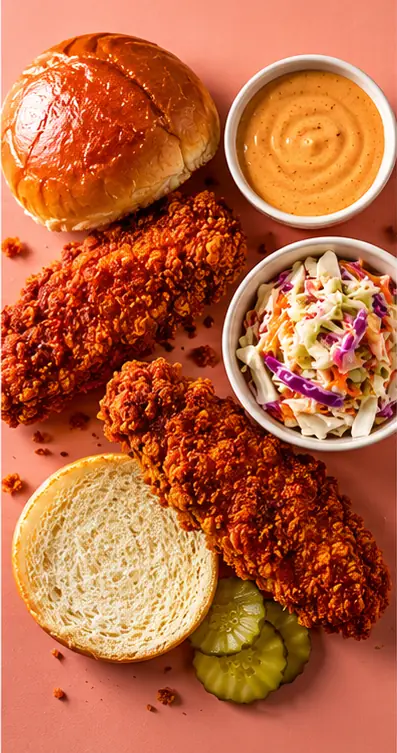
Dave’s tenders are coated and cooked chicken pieces served with bread, pickles and sauce. Those extra components matter for allergens. A person avoiding wheat, egg or milk should not assume an item is safe based only on the fact that the main ingredient is chicken. Coating, seasoning, dipping sauce and bread may contain additional ingredients.
Similarly, choosing No Spice changes the heat selection but does not eliminate all the other components of the meal. Removing the slice of bread also does not prove the chicken coating is wheat-free or that equipment is kept separate. A menu modification is not a reliable allergy-control process unless the restaurant explicitly confirms the whole preparation is suitable.
Sliders, buns and toppings
A slider usually includes chicken in a potato bun with kale slaw, pickles and Dave’s Sauce. This adds ingredients beyond the chicken itself. The bun can matter for wheat or sesame questions. The slaw and sauce can matter for other allergens. You should check each component, not assume the sandwich has the same allergen profile as a separate tender.
Online ordering screens sometimes allow a guest to remove the bun or sauce. Such choices may help with ordinary taste preferences. They do not automatically make an item safe for an allergy because ingredients can remain in breading or be transferred through shared surfaces and utensils. If you need a reliably allergen-free meal, the restaurant must address that need directly.
Sauces, cheese and dairy-rich sides
Dave’s Sauce, ranch and other dips are distinct recipes. The exact ingredients can change by sauce. A guest with an egg, soy, milk or other allergy needs to check each sauce rather than treating every dip as interchangeable. The small sauce container served with a tender is also different from the coating on the chicken.
Hot Mozz is a fried mozzarella item, so its central ingredient is cheese. Mac and cheese and milkshakes are also dairy-based food choices. Loaded fries can add cheese sauce, bites and other toppings. These are obvious reasons to investigate milk ingredients, but the complete allergen profile still needs current first-party confirmation.
Check more than the visible food
The bun, coating, sauce and nearby kitchen equipment all belong in a serious allergy conversation. This photo is illustrative and cannot show cross-contact.
Fries, fryers and cauliflower products
Fries and shared fryers
Fries appear simple when you look at the potatoes alone. But the risk question at a restaurant includes seasoning and preparation. Food may be cooked in equipment that is also used for breaded chicken or other products. We cannot verify dedicated fryers at each Dave’s location. For a person with a serious allergy, that information matters more than whether potatoes naturally contain the allergen.
Ask whether the fryer and utensils are shared with foods containing your allergen. Ask if there is a documented process to keep the food separate. If the restaurant cannot confirm the necessary controls, do not rely on an independent blog’s description of fries as safe. Cross-contact may happen even when an allergen is not an intentional ingredient.
Cauliflower does not mean allergen-free
The NOT Chicken line uses cauliflower as its main ingredient for certain tenders, sliders and bites. That can be useful for guests who prefer not to eat chicken. It does not automatically mean the finished product is vegan, gluten-free, milk-free or egg-free. The breading, sauce, bun and method of preparation may still be relevant.
It also matters whether cauliflower and chicken items use the same equipment. We have not inspected those kitchens and do not claim the products are separated. Read the official allergen information and speak with the chosen location. Our gluten-free options guide explores the separate question of gluten ingredients and shared fryers.
Questions worth asking before your order
Allergy versus a dietary preference
A guest may avoid a topping because they dislike it. Another person may need to avoid the same ingredient because of a medically significant allergy. These situations are not equivalent. A menu button that removes slaw or sauce may be enough for the first situation but may do nothing to control cross-contact for the second.
When you contact the restaurant, explain that your question concerns a food allergy and identify the specific ingredient. Ask about the exact food, any sauces, the preparation area and the fryers. If the team cannot offer clear information, it is safer to choose a restaurant that can answer your needs rather than guessing.
Questions to ask before ordering
Prepare a short list: Does this exact item contain the ingredient I need to avoid? Are any sauces or toppings added as standard? Is the food fried with products containing that ingredient? Are utensils or preparation surfaces shared? Can the restaurant confirm how it handles requests involving that allergen? Ask about your exact store rather than a generic national menu.
If the answer is uncertain, do not assume that a smaller serving or removing one topping solves the problem. With a serious allergy, uncertainty is important information. Your healthcare professional can help you plan how to avoid your allergens and how to respond to an exposure. A third-party menu site cannot make those medical decisions for you.
Why ingredients and kitchen practices can change
Do the allergen details ever change?
Ingredients, suppliers, specials and recipes can change. A printable sheet from one year may not cover a new limited-time food. Even a document labeled 2026 should be checked for the specific item and against any newer restaurant information. This is why our article links to the live official resource instead of copying a long allergen matrix that could become outdated.
A good online guide should be honest about limits. We have not tested food or reviewed supplier declarations. We cannot guarantee the absence of allergens in any menu item. We also do not present a third-party chart as an official certificate of kitchen safety. For a current answer, contact your restaurant and refer to its latest published resources.
What to remember
The safest approach is to identify the exact food, check its current ingredients, and ask about cross-contact at the restaurant where it will be made. Start with Dave’s own 2026 allergen information and use the FDA’s general guidance to understand why shared preparation matters. Menu photos and informal ingredient guesses are not enough for serious allergies.
If you want to compare the main food categories first, visit our Dave’s Hot Chicken menu with prices. For nutrition rather than allergens, see our calories and nutrition guide. This article is designed to help you ask better questions, not to certify any item as safe.
This independent guide is not owned by or affiliated with Dave’s Hot Chicken. Availability, ingredients and preparation can vary by restaurant.