Dave’s Spicy Buffalo Mac: Calories and Sizes
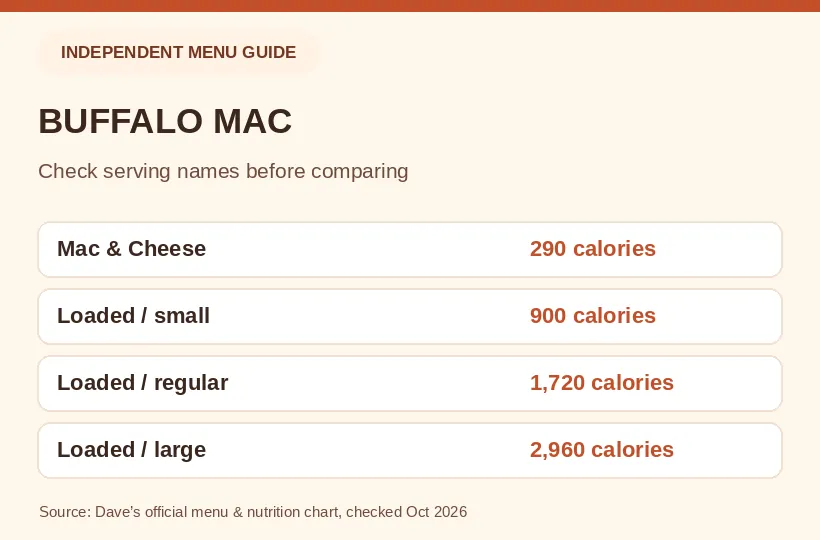
Compare Dave’s Mac & Cheese at 290 calories with Top-Loaded Buffalo Mac at 900, 1720 and 2960 calories for small, regular and large.
Dave’s menu includes basic Mac & Cheese and several buffalo-flavored variations. The names can sound close even when the nutrition is far apart. The official food chart shows a regular Mac & Cheese side at 290 calories. It also lists Top-Loaded Buffalo Mac in three sizes, beginning at 900 calories and reaching 2,960 for a large order. A casual menu description that says only ‘buffalo mac’ can hide that difference. Here is how to read the official serving details and avoid comparing a side dish with a much bigger loaded meal.
The 2026 chart lists plain Mac & Cheese at 290 calories. Separately, Top-Loaded Buffalo Mac runs 900 calories for Small, 1,720 for Regular and 2,960 for Large. These are different menu products and serving sizes.
What the plain Mac & Cheese contains
The standard Mac & Cheese side has a 215-gram serving in Dave’s published nutrition chart. It lists 290 calories, 16 grams of fat, 25 grams of carbohydrate, 14 grams of protein and 1,090 milligrams of sodium. This is a useful baseline when looking at side substitutions and meal additions. You should not assume it equals a bowl topped with chicken bites or spicy buffalo sauce. The plain item is also marked for milk, egg and wheat in the allergen guide. Those ingredients matter more than the calorie count for someone who needs a strict food restriction.
Buffalo flavor versus a loaded product
A location menu may list Spicy Buffalo Mac & Cheese as Dave’s Mac & Cheese with ranch and spicy buffalo drizzles. That product description is not automatically identical to the chart’s Top-Loaded Buffalo Mac. The latter is a separate prepared food with sizes and much higher published totals. Before using a nutrition number, check the complete product name on the menu. If it only says Spicy Buffalo Mac & Cheese, do not silently assign the loaded large nutrition row to it. Ask the restaurant which current nutritional entry matches the item if the online screen is unclear.
| Menu item | Official calories | Important note |
|---|---|---|
| Mac & Cheese | 290 cal | Side dish |
| Top-Loaded Buffalo Mac Small | 900 cal | 321 g serving |
| Top-Loaded Buffalo Mac Regular | 1,720 cal | 614 g serving |
| Top-Loaded Buffalo Mac Large | 2,960 cal | 1,068 g serving |
Small Top-Loaded Buffalo Mac nutrition
The official Small Top-Loaded Buffalo Mac row lists 321 grams and 900 calories. It also gives 70 grams of total fat, 49 grams of carbohydrate, 20 grams of protein and 2,260 milligrams of sodium. This is considerably larger in energy than the standard 290-calorie Mac & Cheese side. The word Small refers to its position within that loaded item’s size range, not a promise of a low-calorie dish. Someone comparing menus should look at both the product category and its serving weight. A small loaded item can be more substantial than a regular side dish.
Regular and Large loaded mac figures
The Regular Top-Loaded Buffalo Mac line shows a 614-gram serving with 1,720 calories and 39 grams of protein. The Large line shows 1,068 grams with 2,960 calories and 66 grams of protein. Those published figures come with high sodium totals as well: 4,010 milligrams for Regular and 7,020 for Large. These rows reflect substantial portions and should not be treated as equivalent to a 215-gram side. If you plan to share one, divide your actual serving thoughtfully, rather than assuming each person will eat exactly half. Dave’s notes that preparation and portion sizes can vary.
Are these items high in protein?
The loaded mac rows contain 20, 39 and 66 grams of protein for the three published sizes. Those values are substantial, but they come with large calorie and sodium totals too. Protein content alone does not tell you whether a food meets your health goals. A smaller chicken item or a separate mac side may be a more appropriate choice if you do not want such a large portion. Use the complete table and your own dietary needs instead of ranking foods by one nutrient. For a medically necessary diet, professional advice is more useful than a restaurant comparison page.
Allergen and sauce questions
Dave’s allergen chart marks the Top-Loaded Buffalo Mac as containing egg, milk, mustard, soy and wheat. The plain Mac & Cheese also has allergens. If you have a food allergy, removing a topping does not make shared equipment or prepared components automatically safe. Buffalo sauce, ranch and any chicken added to a product can change the ingredients. Use the current allergen PDF and tell the store about your needs before ordering. Do not assume a vegetarian-looking macaroni item is a fully vegetarian prepared meal without verifying all ingredients and kitchen practices.
Comparing prices and menu sizes fairly
A basic Mac & Cheese side may cost much less than a Top-Loaded Buffalo Mac meal because it is a different product and serving size. Dave’s location menus can show different prices for each. Avoid comparing a Side Mac with a Regular Top-Loaded Buffalo Mac by looking only at the word ‘mac’ in the title. If you already have a tender or slider combo, a separate small side may be enough. If you want a larger mac-centered meal, the loaded product could be what you intended. Always check the exact item and portion at your restaurant.
A clear ordering checklist
Read whether the item is called Mac & Cheese, Spicy Buffalo Mac & Cheese or Top-Loaded Buffalo Mac. Next, check its listed size and whether it includes added chicken, sauce or other ingredients. Choose your restaurant and examine available options in the live order screen. Then compare the official nutrition row for the exact matched product. If the row is missing, say so rather than borrowing another product’s numbers. Finally, consider extra fries, a shake or drink separately. Counting one clearly identified order is much more reliable than combining unrelated calorie guesses.
Frequently asked questions
Is Spicy Buffalo Mac always 900 calories?
No. The official 900-calorie row is specifically for Small Top-Loaded Buffalo Mac. The separately named Spicy Buffalo Mac & Cheese on a local ordering screen may be a different product. Compare full names and serving sizes before assigning nutrition figures, and ask the restaurant if the current naming is confusing. Some online menus feature plain Mac & Cheese and Spicy Buffalo Mac near each other, even though loaded versions use different portions. Use the complete item name and any available serving weight, then confirm the store’s current menu before relying on one calorie number.
Why does the large version have so many calories?
The published large Top-Loaded Buffalo Mac serving weighs 1,068 grams, far more than the standard 215-gram Mac & Cheese side. Its chart shows 2,960 calories. That figure describes the listed full serving, not a small tasting portion. If the food is shared, each person’s actual intake depends on how much they eat. The size and ingredients of the food are what create the published total. If you divide a larger portion among friends, document how much each person ate rather than assigning every diner the entire listed value or pretending an equal share was guaranteed.
Is Mac & Cheese suitable for a dairy allergy?
No. Dave’s official allergen guide marks milk in Mac & Cheese and loaded Buffalo Mac. The latter also has other allergens. A person with a serious allergy should talk directly with their restaurant because recipes and shared preparation matter even when a modifier or substitution appears simple. A safe decision also depends on how a restaurant prepares its sauces and handles shared equipment. If an ingredient matters for your health, review the current allergen matrix and talk with staff instead of trying to infer safety from a short product name.
Sources and related menu guides
Dave’s published 2026 food nutrition chart provides the reported serving values, while its 2026 allergen information explains declared allergens and kitchen cross-contact. The official location ordering menu shows current product names and availability. Figures reflect published standard servings, not a test of each individual order. We do not claim to have tasted or weighed the food.
See our Dave’s Hot Chicken menu and prices, general nutrition guide, allergen guide and Menu Guide. Other nutrition articles: daves hot chicken combo calories, daves fries cheese fries calories, daves hot mozz calories nutrition, daves cauliflower menu nutrition, daves mini sliders calories nutrition. These pages help you compare products without assuming one meal suits every person.
What to remember
The 2026 chart lists plain Mac & Cheese at 290 calories. Separately, Top-Loaded Buffalo Mac runs 900 calories for Small, 1,720 for Regular and 2,960 for Large. These are different menu products and serving sizes. Select the exact store and item before buying. If you customize the food, the standard nutrition figures may no longer match what is in your bag. For allergies or medically necessary diets, consult the official documents and ask the restaurant about preparation. A useful menu guide should explain what is known and where the published data ends rather than guessing the difference.
Related guide: basic Spicy Buffalo Mac side.
Editorial note: This independent site is not operated by Dave’s Hot Chicken. Official food nutrition chart revised March 16, 2026 and allergen chart revised June 29, 2026. Original diagrams are informational, not photographs of a restaurant serving. Last reviewed October 30, 2026.